
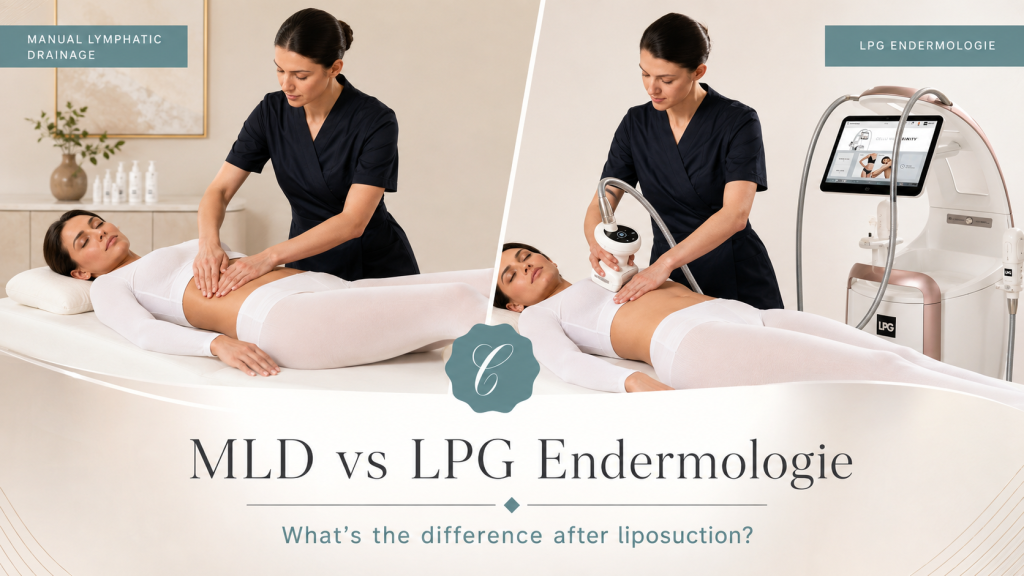
Manual lymphatic drainage and LPG Endermologie both support post-liposuction recovery in different ways. The most suitable approach depends on your healing stage and tissue condition.
If you have recently had liposuction, you may have been advised to consider “lymphatic drainage.”
But when you start searching, things can become confusing.
Some clinics offer Manual Lymphatic Drainage (MLD). Others offer machine-assisted treatments such as LPG Endermologie. And both may be described as helping with post-liposuction swelling.
So are they the same thing?
Not quite.
Both approaches may support fluid movement during recovery, but they work differently — and the most appropriate choice can depend on where you are in the healing process and what your tissues actually need at that stage.
At Chez Moi, we believe understanding that difference is more useful than simply asking which treatment is “better.”
First, what happens to the lymphatic system after liposuction?
Liposuction does more than remove fat.
During the procedure, small blood vessels, lymphatic vessels and surrounding connective tissues are also temporarily disrupted. Inflammation follows as part of the normal healing response.
This is why clients commonly experience:
- swelling
- heaviness
- fluid retention
- tenderness
- numbness
- tissue firmness
- uneven or hardened areas
The lymphatic system helps move excess fluid and cellular waste away from tissues. Unlike blood circulation, it does not have a central pump like the heart, so movement, breathing, muscle activity and external stimulation all contribute to lymph flow. Your existing post explains this recovery process in more detail.
This is where lymphatic drainage treatments may come in.
What is Manual Lymphatic Drainage?
Manual Lymphatic Drainage, commonly shortened to MLD, is a specialised hands-on technique.
It typically uses very light, rhythmic movements intended to encourage lymphatic fluid to move toward functioning drainage pathways.
It is not the same as a deep-tissue or slimming massage.
In fact, proper MLD is usually quite gentle.
Medical literature describes MLD as a specialised massage intended to support the filling and emptying of lymphatic vessels. It is widely used as part of conservative lymphoedema management, although the strength of evidence varies depending on the condition being treated.
In the post-liposuction setting, MLD may be particularly useful when the main concern is early swelling and fluid congestion, provided the surgeon has cleared the client for treatment.
What is LPG Endermologie lymphatic drainage?
LPG Endermologie takes a different approach.
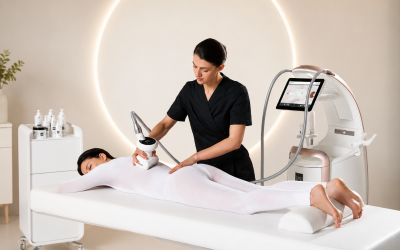
Instead of using the therapist’s hands alone, LPG uses a motorised treatment head combining controlled suction and mechanical tissue mobilisation.
At gentle settings, the treatment can be used to support circulation and fluid movement.
But LPG has another advantage: as recovery progresses, the treatment can be adapted to work on tissue mobility, not simply swelling.
That becomes relevant because post-liposuction recovery often changes over time.
Early on, the concern may largely be oedema.
Several weeks later, a client may instead notice:
- areas that feel firm or “woody”
- pulling or tightness
- uneven tissue
- reduced skin glide
- scar restriction
- developing fibrosis
LPG’s mechanical stimulation can then be adjusted toward tissue mobilisation and flexibility rather than being used purely as a drainage treatment. Your LPG recovery material specifically describes uses including lymphatic drainage, scar mobilisation, tissue softening and improving tissue flexibility.
So what is the main difference?
A simple way to think about it is:
| Manual Lymphatic Drainage | LPG Endermologie | |
|---|---|---|
| How it is performed | Therapist’s hands | Motorised treatment head |
| Typical pressure | Very light and rhythmic | Adjustable mechanical stimulation |
| Early recovery focus | Fluid movement and swelling | Gentle fluid movement and circulation support |
| Later recovery use | Can continue supporting drainage | Can be adapted toward firmness, tissue mobility and restriction |
| Treatment consistency | Depends partly on therapist technique | Machine parameters can be adjusted and reproduced |
| Fibrosis / restriction work | May involve additional manual techniques beyond traditional MLD | Mechanical tissue mobilisation can be progressively introduced |
The important point is that these are not simply two versions of exactly the same treatment.
Traditional MLD is primarily a lymphatic technique.
LPG can begin gently with a drainage-oriented approach and then evolve into a broader tissue-recovery treatment as healing progresses.
Does that mean LPG is better than MLD?
Not necessarily.
This is where we think the conversation should become more nuanced.
There may be circumstances where gentle manual drainage is particularly appropriate, especially in the earlier stages of recovery.
There may also be circumstances where LPG becomes useful later, when swelling is no longer the only concern and the tissue begins to feel firmer, less mobile or restricted.
The right question is therefore not:
“Which treatment is better?”
It is:
“What does my body need at this stage of healing?”
That is an important distinction.
Why the recovery stage matters
Post-liposuction recovery is not static.
The tissues you feel at two weeks can be very different from what you feel at six or twelve weeks.
For example:
Earlier recovery
The priority may be:
- reducing feelings of congestion
- encouraging comfortable fluid movement
- supporting circulation
- avoiding unnecessary irritation to healing tissues
Treatment should generally remain gentle, and medical clearance is important.
Intermediate recovery
As swelling begins to settle, the therapist may start noticing:
- firmness
- tissue resistance
- reduced skin mobility
- areas that feel harder than surrounding tissue
Treatment may gradually shift from primarily drainage toward gentle tissue mobilisation.
Later recovery
When tissues are stable, the focus may increasingly include:
- fibrosis or persistent firmness
- scar mobility
- restricted tissue glide
- skin suppleness
- contour refinement
This staged approach is one reason Chez Moi does not use exactly the same LPG programme for every post-liposuction client.
What about fibrosis?
This is another area where the difference between drainage and tissue mobilisation becomes important.
Fibrosis refers to areas of firm or hardened healing tissue. Clients may describe these areas as:
“lumpy,”
“ropey,”
“stuck,”
“hard,”
or “tight.”
Traditional lymphatic drainage alone is principally aimed at fluid movement.
Once a tissue problem becomes more about firmness or restriction than fluid, the recovery strategy may need to change.
That does not mean aggressive treatment.
In fact, overly forceful massage can irritate healing tissues.
Instead, the aim is usually progressive, controlled mobilisation to encourage the tissue to become softer and more mobile over time.
Post-liposuction fibrosis and tissue remodelling can continue for months, so gradual improvement is more realistic than expecting a hard area to disappear after one treatment. Your existing recovery article also emphasises that tissue recovery is gradual.
Does LPG replace a trained lymphatic therapist?
No.
MLD and LPG are different tools.
A skilled manual therapist can assess tissue directly with their hands and adapt treatment moment by moment.
LPG provides another form of controlled mechanical stimulation that can be useful across different stages of recovery.
At Chez Moi, we do not see technology as replacing professional judgement.
The machine is simply one part of the treatment.
The assessment comes first.
What should be assessed before treatment?
Before starting post-liposuction recovery treatment, we look beyond the amount of swelling.
We also consider:
- how many weeks you are post-surgery
- which areas were treated
- what type of liposuction was performed
- where swelling is located
- whether the tissue feels soft, firm or restricted
- whether the skin moves freely over the tissues underneath
- tenderness or altered sensation
- incision healing
- your surgeon’s instructions
This helps us decide whether the priority should be drainage, tissue mobilisation, or simply allowing more time for healing.
When should massage or LPG be postponed?
Post-liposuction treatments are supportive care. They are not a substitute for medical assessment.
Treatment should be postponed and the surgeon or medical team contacted if there are concerning symptoms such as:
- increasing redness or heat
- fever
- worsening or sudden swelling
- leaking or open wounds
- a fluctuant fluid-like pocket
- rapidly increasing pain
- an unusual enlarging lump
- calf pain or significant one-sided leg swelling
- chest pain or shortness of breath
When something does not look like ordinary postoperative healing, the appropriate next step is medical review — not stronger massage.
So which should you choose after liposuction?
For some clients, manual lymphatic drainage may be an appropriate early recovery option.
For others, LPG Endermologie may offer a useful way to begin with gentle drainage support and later progress toward tissue mobilisation as healing advances.
And some clients may benefit from different techniques at different stages.
There is rarely a single protocol that suits everyone.
At Chez Moi, we prefer to assess how the tissue is actually healing rather than treating every post-liposuction client in exactly the same way.
Because good recovery care is not simply about reducing swelling.
It is about supporting the tissue through the different stages of healing — patiently, progressively and with respect for what your body is ready for.
Related Articles:
- What Is Fibrosis After Liposuction? Understanding Hard Lumps, Tightness and Tissue Healing
-
Scar Adhesions After Surgery: Why Does My Skin Feel Tight or Stuck?
-
What Should You Eat After Liposuction? Simple Nutrition Tips to Support Recovery
- LPG Endermologie for Post-Liposuction Recovery Care